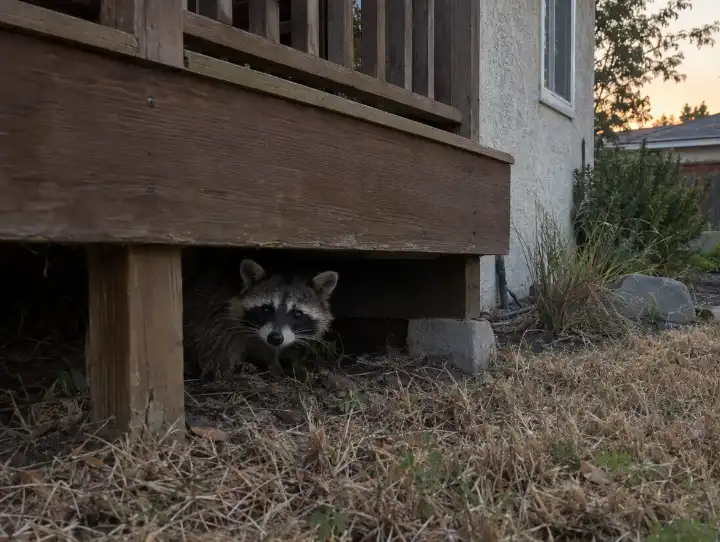
Which animal is it?
| Animal | Where it dens | How it’s kept out |
|---|---|---|
| Raccoons Young arrive April or May. | Under decks, in attics and chimneys, and in spaces beneath houses. | Heavy mesh, because they're strong. UC IPM calls for 10-gauge galvanized mesh with 1/4- or 1/3-inch openings, buried 6 inches and bent 12 inches outward. |
| Skunks Breed February to March, about 9 weeks' gestation. | Under decks, porches and the floor of the house. | A one-way gate at the den, then 1/4-inch hardware cloth buried at least 6 inches along the edge. |
| Opossums They use existing gaps rather than digging new ones. | Under steps, porches and decks, in attics and garages, and beneath houses. | 1/4-inch hardware cloth over the openings once a flour tracking patch shows the animal has left. |
| Tree squirrels Eastern fox squirrels can be controlled by the owner; gray squirrels need a CDFW permit. | Gaps under the eaves and where roof sections overlap, often reached from branches. | Sheet metal or 1/4-inch hardware cloth over the entry, and limbs cut back from the roof. |
Source: UC IPM Pest Notes for raccoons, skunks, opossums and tree squirrels.
Smaller, faster scratching at night, especially overhead, is more likely rats. See rat removal.
How exclusion works
Tracks, dug soil, torn vents or lattice, and droppings show where the animal gets in and dens.
Especially in spring. Young that can’t walk won’t follow the mother out.
A one-way door or gate over the opening lets it out but not back in. A flour tracking patch confirms it’s gone.
Galvanized mesh over openings. Under decks and sheds it’s buried at least 6 inches and bent outward so digging hits wire.
Torn vents, insulation or ducting. See attic cleanup.
Timing and babies
Most wildlife problems peak when animals are raising young. UC IPM puts raccoon births in April or May, and skunks breed in February and March with about nine weeks’ gestation. Sealing an opening in spring without checking can trap young inside, which means a dead-animal smell and a second job. Checking for young first is part of doing it right.
What California allows
- No relocating. Raccoons, skunks, opossums and other wildlife can’t be moved elsewhere without written CDFW permission (UC IPM; 14 CCR §679).
- Trapped animals must be released where they were caught or dispatched, and traps must be checked at least once a day (14 CCR §465.5).
- Trapping for pay requires a CDFW trapping license, with exemptions for licensed pest-control operators handling rats, mice and similar rodents (Fish and Game Code §4005).
So the right method for most homes is exclusion, not removal.
What it costs
Published national figures put wildlife removal anywhere from about $150 to $600+, with screening and repairs on top. Prices vary with access and the animal. Ranges and sources are in the cost guide.
Sources
- UC IPM Pest Notes: Raccoons: revised July 2014
- UC IPM Pest Notes: Skunks: revised April 2015
- UC IPM Pest Notes: Opossum: revised October 2015
- UC IPM Pest Notes: Tree Squirrels: updated August 2016
- 14 CCR §679 (wildlife under buildings)
- 14 CCR §465.5 (trapping)
- Contra Costa Mosquito & Vector Control District: services
- Angi: Wildlife removal cost: updated September 9, 2026